Thursday, 4 December 2014

Tiny Toon Adventures: Buster Busts Loose!

System(s):
Super Nintendo

Genre: Platformer

Developer: Konami
Publisher: Konami

Release Dates:
Japan - December 1992
North America - February 1993
Europe - June 1993


Tiny Toon Adventures was a popular children's cartoon that aired from the late 1980's until 1992, as a series based on the lives of younger protégés of Looney Tunes characters attending university. A number of cartoons and toy franchises made the leap into games in the heyday of the NES and SNES, such as Bucky O'Hare, Captain Planet, Chip n' Dale Rescue Rangers and Monster In My Pocket. What was different about Tiny Toons though was it's enduring legacy. It was so popular that it spawned many games across multiple systems right up until 2002, and some of them were pretty good as far as those type of games go. It was also the first collaboration between Warner Bros. and legendary director Steven Spielberg's Amblin Entertainment, which would also produce Animaniacs and Freakazoid. Tiny Toons captured much of the humour and tone of the original Looney Tunes but with a new generation of fans to enthral.

Readers of previous posts on this blog (all five of you) may be aware of my paranoia about licensed material being used for video games. Tiny Toons certainly had very mixed results as a video game, and unfortunately Buster Busts Loose! epitomises this trend.

Released in 1993, after the show's original run on television ended, Buster Busts Loose! is a platform game but with a couple of unique innovations to distinguish it from the crowd. The biggest difference between this and most platformers is that you can use the shoulder buttons to dash, which will send you running up walls to reach important items and solve puzzles. The second stage in particular makes heavy use of this feature, and you can move pretty fast across levels, so you have to be careful when using it not to bump into enemies. You can attack while dashing by pressing down on the control pad, but this attack can be risky. Standard attacks are done by pressing the Y button, which causes Buster (sadly the only playable Toon in this game) to do a somersault kick.

Stages are subdivided into sections, and every one of them has a theme. The plot is very simplistic, and most stages are based on popular films like Star Wars or Back to the Future Part 3 that were referenced in specific episodes of the series. The various themes mostly keep things fresh and interesting. What's more, in between each stage is a roulette that grants you the chance to play a mini game for extra lives. Another high point is that, in the middle of all this jumping and dashing (although with zero context given), there is a stage which sees you playing a brief game of American Football in order for Acme Looniversity to beat their hated rivals, and besides the runaway train in stage two, is the most exhilarating part of the main story. I found myself going back to this level using passwords just because it feels so fresh compared with the regular challenges the game offers.

Buster Busts Loose! is a very short game, and won't last more than four or five hours. There are three difficulty modes, although in true Konami style, the easiest mode is a bit pointless as it removes both bosses and the ending. If you want to experience the game properly, normal difficulty or higher is recommended, although it's not particularly taxing anyway. There is also a password system where you match up three characters from the show, although you will rarely need it except to access mini games.

The most unusual thing about Buster Busts Loose! is that the most entertainment to be gained is from the mini games, each one represented by a character and colour on the roulette. These include a maze, sliding puzzle, bingo, squash and an odd game where you have to outweigh your opponent. The bingo and scales games just boil down to luck and aren't much fun. The sliding puzzle is decent, but nothing special, and the maze game, as much as I enjoyed it, is far too difficult as there are three enemies wandering around, two of which move quite fast. If you get hit by any of them it's game over. The highlight is Furball's squash game, in which you rebound the ball against the wall. After a certain number of hits it will give you a one-up, but also make the ball speed up, making successive on-ups harder to achieve. Other characters will appear, and hitting them will give you power ups or additional one-ups. There is a password that let's you access these games without having to finish a stage and it says quite a bit about the game that I probably used that password most often.


Buster Busts Loose! is a colourful and gorgeous looking game, with detailed backdrops, such as the art room featured on
the first stage. The character sprites look exactly like their cartoon series counterparts, and a generous number of characters make an appearance, from series regulars Shirley the Loon and Hamton Pig to more minor characters like Bookworm and Montana Max's buff bodyguard, Arnold the Pitbull. Most characters are unfortunately relegated to bit-part roles, either as antagonists or NPC's. The soundtrack is not the most memorable but the animation is top notch for a 16-bit SNES title.

Overall, Buster Busts Loose! is a pretty short game, and it's over before it really gets going. It's a shame, as it draws from it's source material extremely well, and would benefit from a couple of extra stages and an extra playable character. The mini games and football stage do give it some extra replay value. If I was going to recommend a Tiny Toons game, it would probably be it's 8-bit NES counterpart, the not-so-imaginatively titled Tiny Toon Adventures. It may not have the enjoyable mini games, but it does feature more than one playable character and a greater challenge.


Summary

+ Quite faithful to the cartoon series
+ Mini games are a lot of fun
+ Some good variety in the levels
+ Gorgeous character sprites and backgrounds

- Very short game
- Lacking in challenge
- Platform gameplay could benefit from more than one character
- Saying it has a plot would be generous


Overall Score
6/10


Sunday, 1 June 2014

The Adventures of Bayou Billy

System(s): Nintendo

Genre: Action Adventure

Developer: Konami
Publisher: Konami

Release Dates:
Japan - August 1988
North America - June 1989
Europe - January 1991


I'm sure I'm not the only person who, upon seeing Bayou Billy for the first time, thought it was a Crocodile Dundee knock-off. My first impression based on cover art alone was that Konami had somehow failed to secure the rights to the franchise and resorted to playing copycat instead. It seems too much of a coincidence that Crocodile Dundee was at the peak of it's popularity. Perhaps there was some inspiration from the Australian hero, but the Louisiana setting, pitting Billy against a gangster known as Godfather Gordon "the gangster king of Bourbon Street", attempts to make this game stand alone. And stand alone it does.


Bayou Billy was a budget game on release, for all intents and purposes, but a decent one at that, and better than a licence game would have merited anyway, if the relationship between NES games and movie licences is anything to go by (I'm looking at you LJN!). It features three distinct gameplay styles in one game, being subdivided into side-scrolling beat em' up, driving and light gun sections. The main menu has game modes "A" and "B", although only leafing through the manual gives you any clue as to what the difference is. This certainly doesn't make the game feel like it's aged well. I mean, when was the last time anyone actually had to read a manual to figure out a game? But I digress. The difference between the modes simply boils down to using the controller only for "B" rather than the light gun for the shoot em' up sections, in case you don't have a light gun (or can't be bothered/forgot about plugging it in). Why they didn't just make this a separate menu screen literally asking you if you wanted to use the gun or controller, I have no idea. Maybe they ran out of data for the cartridge?

The action in Bayou Billy was and still is known for it's difficulty. This is supposedly because there was an error in the international versions, making the enemies 1.5x faster and giving them more hit points. At least I hope it was a mistake and not a means of making the game last longer. Bayou Billy is a short game, so this sort of trick wouldn't surprise me. At any rate, the beat em' up stages can be frustrating as a result. Enemies feel a bit cheap and they can be damage sponges, soaking up hits while they corner you three on one. Health is also pretty scarce and continues few. This is unfortunate because these stages are pretty fun otherwise. Apart from the crocodiles. Oh these crocodiles.....having to kill them is tedious and takes way too long, which could be said for most enemies in the fighting stages. To get past these crocs you either wade in and time your punches perfectly and get REALLY close, or stand on dry land and kick from a distance, which is tedious in the extreme.

These stages do give you a variety of weapons like bullet proof vests, guns, two-by-fours and best of all, a whip. The whip is the most fun I've had in a NES game with a power up. You can kick, punch and use a jump kick, but I found the punch mostly worthless, as it requires you to get in very close. The jump kick is useful on occasion but as soon as you get your hands on a weapon you'll really want to use it. You also get some bosses thrown in for good measure, although thankfully they are reasonably slow compared with regular foes. The boss music is particularly good too, as is the beat em' up stage theme.

The shooting stages of Bayou Billy are the most fun I had with the game. I actually played through the game anticipating the shooting stages, and every time one of the others appeared instead, my heart sank a little. I think that's a good indication of how engrossing this part of the game is. You contend with bazooka enemies hiding in the swamp, who
occasionally drop nifty power ups like more bullets, or stars that destroy all enemies on screen at once. Also out to take you down are machine gun wielding thugs that drop down from seemingly nowhere. They can be a pain, as they will run across the screen back and forth before stopping to fire. It does add to the tension though. There is a very nice non-swamp gun stage as well. The action is engaging enough, even if it doesn't last too long. It's a pity there are so few stages, most of those to be found in the game are the beat em' up variety. More shoot em' up stages would have given this game a whole lot more replay value. The bosses here are probably the more memorable ones in the game besides the final encounter and the pressure during the fights is enormous. You start back at the boss when you die but it's probably just as well as going all the way back would be a nightmare.

Finally, you get two driving stages. There's not a whole lot to it, you basically dodge rocks and blast other cars, while firing grenades at planes and helicopters, all while trying to manoeuvre your way along tough bends and beat a time limit. It's probably a good thing there were only two of these, as they were probably the least memorable stages in the game, and a little simplistic. It can ratchet up the tension a bit when you are dodging rocks, destroying jeeps and blowing up planes all at once, but there is very little else worth mentioning. The controls of both the driving and fighting stages are pretty poor, and with a NES controller, is a sure-fire way to give yourself hand cramp.

Bayou Billy looks very good given the limitations of the NES. There are a variety of enemy sprites although the first enemies look a bit boring and have a bit of a strange colour palette. Shocking pink is more likely to draw laughs than anything else, so you have to wonder what they were thinking making the tougher of the standard enemies pink. Most enemies' toughness is denoted by colour in this way, so it's standard 8-bit character design.

There really aren't a whole lot of locations in the game to be honest so it's good that they fill the space between stages with cut scenes featuring Gordon. Between levels he will taunt you, with stereotypically distressed damsel Annabelle tied up helplessly beside him, thankfully not tied to any railroad tracks. It's a nice touch to have these scenes. One highlight is at the end of a fighting stage where you come across a truck driving away with Annabelle's screams heard from inside. The game over screens show a similar dramatic flair in spite of the limitation of the technology. They show Billy lying in the mud, arm outstretched toward the player, and during the gun portions Billy's hat is flying off while he clutches at a bullet wound in his chest. It really feels like you've failed the poor guy. As if the frustration of failure wasn't enough, you have guilt to add to that too. The narrative is a towering strength of Bayou Billy. There was originally an amusing alternative ending in the Japanese version, but unfortunately that was left out in subsequent releases.

Bayou Billy is a passable attempt at a very diverse action game, where the shooting segments stand out as the core strength of the gameplay. It probably would have been more acclaimed on release had the street fighting not been made more difficult in the worldwide release, and the driving stages are mostly forgettable filler. Bayou Billy PAL/NTSC fails to feel like an epic quest to save Annabelle, because it's too short, but is also inferior to it's Japanese counterpart, Mad City. It's not a game I would recommend easily, although anyone interested in playing one of the few games that used Nintendo's Light Gun peripheral well but not exclusively might want to pick it up.


Summary

+ Most fun I've had with the Light gun since Duck Hunt
+ Great narrative for an 8-bit game
+ Some fun weapons
+ Gameplay gives people some variety, even if all parts aren't equal
+ Nice graphics

- Inferior to the Japanese version
- Very short
- Fights can feel cheap
- Driving stages forgettable
- Not enough of the one thing that kept it going - the shoot em' up stages
- Confusing title menu
- Most stages have poor controls

Overall Score
5/10


Thursday, 17 October 2013

Dragon's Dogma


System(s): PC, Xbox 360, PS3

Genre: Action RPG

Developer: Capcom
Publisher: Capcom

Release Date: May 2012


Note: This review is for the Xbox 360 version only.


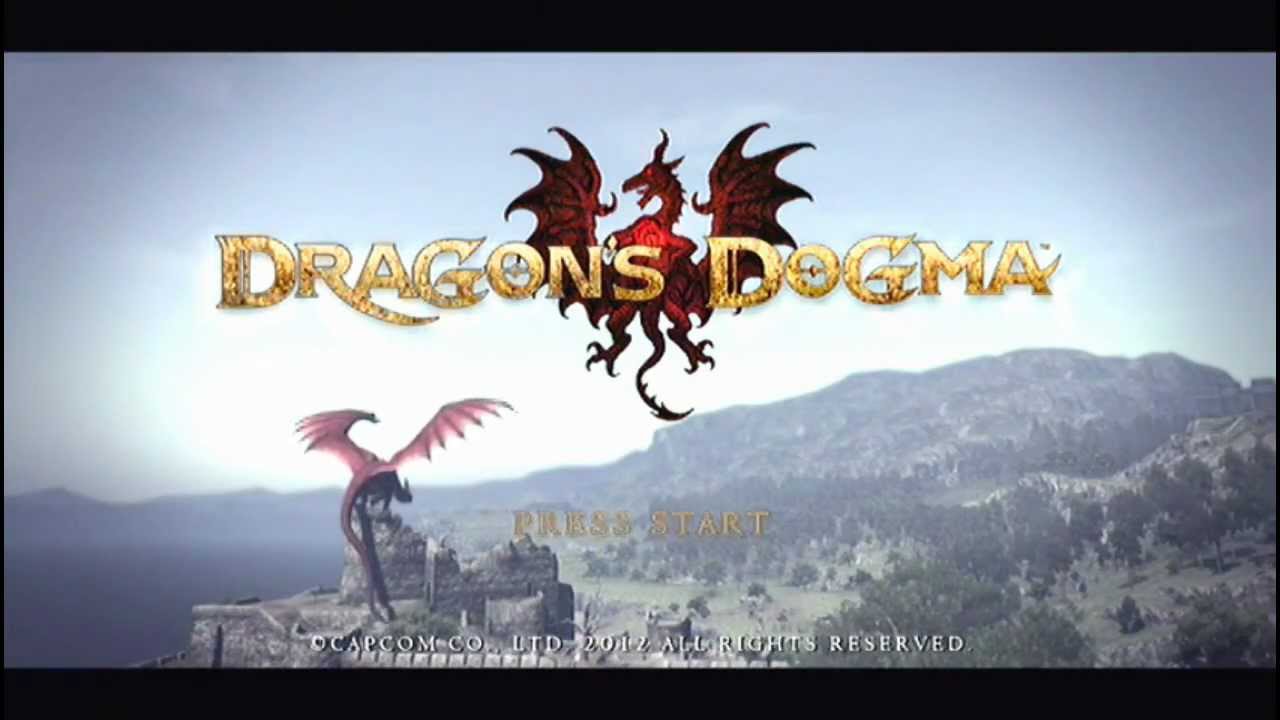
If there is one thing that is a staple of all stereotypical RPG's, it's that you are more than likely going to encounter a dragon. Such an awe-inspiring and iconic symbol of fantasy and perilous adventure is bound to eventually get overused. Thankfully, Dragon's Dogma is on hand to show that dragons haven't been reduced to a tired cliché yet. Dragon's Dogma is an RPG set in a fantasy world but with a twist: you can fully customise both your own avatar and a companion (known as your pawn) to take with you. In addition, you can bring two other party members, taken from the ranks of pawns other players have created, which makes for some weird adventuring parties. But more on that later.

The game opens when it's namesake, a gigantic dragon, decides to pay a visit to your quiet seafront hamlet, Cassardis. After the unwelcome guest becomes a bit of a nuisance, destroying and eating half the village, our plucky hero picks up a sword in a moment of extreme insanity (or stupidity) and promptly gets flattened. After ripping out your heart and keeping it as a gruesome trophy, the dragon double-dares you to win it back. With the dragon's "neener-neener" still ringing in your ears, you become the Arisen, a legendary hero with a husk of a body, but with the supernatural powers of.....erm....recruiting help. Seriously. Summoning characters to assist you. That's your nifty new power. Not weapons or magic, but a conveniently placed game mechanic. This really just feels like the pawn system was wedged into the story.

Apart from the AI being dumber than a bag of hammers, having weird names (that's user created content for you) and the fact they never shut up, pawns will at least give you hints on quests if they are at a higher level and generally don't need too much babysitting. There is a way to reduce the amount of chatter although Capcom made some of these kind of options accessible only via objects in the game rather than through a simple options menu. It would also be nice to have a lot more control over what your pawns actually do as well. While you have some limited directions, they aren't all that useful. You sometimes find yourself being healed while at full health while another party member is dying, for example. But they can generally hold their own in a fight.

The one glaring omission from this game above all others is not being able to have a friend along for the adventure. There is unfortunately no multiplayer to speak of whatsoever, instead, your friends list gets to use your pawn for free, even if they are ridiculously overpowered. You can choose to send an item with them when you dismiss pawns but I can't recall ever getting anything useful from other players. I can't help but think that not having co-op was a missed opportunity.

If not being able to control your pawns is frustrating, at least customising your character and main pawn is a blast. There is tons of loot in this game, and even better, you can craft materials and improve your equipment with items you find. There is a huge variety of trinkets, herbs and monster parts to be found and it's almost as satisfying as in Dark Souls or a traditional rogue-like when you come across a new piece of loot. But nothing beats actually trying out that massive new war hammer on enemies.

This is because the main thing that Dragon's Dogma does exceptionally well is combat. You get a choice of three standard classes common to most RPG's, with plenty of skills to unlock. When you level up, you get points for hiring pawns and spending on upgrading skills. Most of these are great fun to use, although the classes are a little unbalanced. Playing as a mage is not nearly as enjoyable as playing as a fighter or archer, and for people who enjoy unleashing powerful magic, this is a bit disappointing. As a fighter or archer, however, you can string combos together nicely and more importantly climb on enemies backs very effectively, particularly if you chose the nimble, ranged classes. This mechanic is basically what makes the game so much fun when fighting. Jumping on a griffon's back while it flies in the air and hacking at it's neck until it falls to the ground, all the while watching it get peppered with flame arrows is one of the biggest thrills the game can offer.

 Image 1Similarly, coming up with tactics and working together to beat large foes is intensely satisfying. Enemies have strengths and weaknesses to plan strategies for, such as ogres, who will always target female characters. The bosses are excellent as well and the locations atmospheric. Well, when there are monsters to populate them. The world of Glansys is bleak and empty. That does give it a certain charm, but I couldn't help wishing there was more incentive to explore. Capcom has created beautiful looking character models, monsters and occasionally nice scenery, but failed to fill the world with enough "stuff" or diversify the monsters. Even though the scenery is not technically impressive or pushing the hardware to the limit, some pop-in, screen tearing and clipping becomes an issue every so often, and the camera is awkward during fights - the game makes other characters transparent to resolve camera hitches, but is less accommodating of objects like trees or rocks, unfortunately.

In the first half of the game, most of the enemies are chimaeras or goblins with the occasional Cyclops protected by bandits. There is no randomisation to the encounters, which due to the concentration of these enemies makes the middle part of the game a weary slog. Fighting goblins for the umpteenth time becomes repetitive and eventually it becomes tempting to ignore them unless you want crafting items. Even worse, side quests are mostly bland and forgettable, relying on the old fetch quest or escort mission tropes. The main plotline doesn't get going for some time and you can easily fail side quests without having a guide handy to make it clear when they expire.


As for the dialogue and characters, it says something when the mute player character has more personality than the NPC's. It doesn't help their case when they all talk in a really cheesy "ye old" dialect. To add to this tedium, fast travel doesn't become too effective until halfway through the game and you spend much of your time trudging through the half-empty landscape either escorting fragile NPC's with terrible path finding, or running for a few seconds before doubling over from exhaustion. I understand that stamina bars make games seem more realistic, but when your hero topples a mighty golem with minimal effort but cant run across an entire field without stopping every few seconds it doesn't exactly suck you into the game world.

Speaking of destroying immersion....do I need to mention the 'Brine?' Monsters that live in the water and kill you really quickly if you stand in deep water too long? Really? In theory they could have hidden some neat secrets out on little islands somewhere but the water death mechanic makes exploration of the craggy cliff faces more unwelcome than it needs to be. Perhaps swimming with a full plate of armour is also unrealistic, but then why not make the character just drown?

If it sounds as though I hate this game, I don't. I genuinely enjoyed playing it. Most of the time. The upbeat, fast-paced title music is great for psyching someone up for a spot of dragon slaying and the characters and accessories are nicely designed and detailed. Not to mention the beautifully designed monsters, which look imposing enough to make the most battle-hardened adventurer flee in terror....well, in between resting to recover their stamina at least. The main plot is fantastically nutty when it finally kicks in too. But the combat seems to carry the game far too much. It's as if Capcom was so concerned with doing something different and perfecting those differences, they forgot to shore up on the basic mechanics that make an RPG work. There will be plenty of people that will absolutely adore this game, and I can understand why, as it's problems don't diminish the fun factor entirely. But for most people, Dragon's Dogma will be known as the idiot savant RPG of this generation.


Summary
+ Engaging combat
+ Creative bosses and well designed monsters
+ Extensive character customisation
+ Refreshing ideas in an increasingly well-trodden genre

- Side quests break up the main story too often
- Graphical glitches
- Unbalanced classes
- No multiplayer

Overall Score
5/10


Friday, 14 June 2013

Recettear: An Item Shops' Tale


System(s): PC

Genre: RPG/Simulation

Developer: Easy Game Station
Publisher: Carpe Fulgur, Valve Software

Release Dates:
Japan - December 2007
North America - September 2010
Europe - September 2010


Every once in a while, a game comes along with a really interesting concept. A concept that you would love to see work, but which sounds like it doesn't have a hope in hell of making a good game. On occasion, though, as bizarre and "out there" as the idea is, the developer manages to weave it together to make it fit and make for a compelling and addictive experience. So much so that it sucks up your time well into the wee small hours.

Recettear: An Item Shops' Tale is just such a game. An odd mixture of anime characters, rogue-like dungeon crawling and business strategy, Recettear is surprisingly addictive, if a little short. Recettear starts out with the protagonist, Recette Lemongrass, in her home wondering where her father went and agonising about bills - a bit of an odd start to a video game, admittedly, but it sets up the premise nicely. She hears someone at the door, and the debt collecting fairy (it's as bonkers as it sounds) Tear answers, looking to collect on the loans made by Recette's father. Penniless and alone, Recette has no way to pay off her fathers' debt, but Tear makes a deal: if she runs an item shop, she can use the profits to service the debt. It's no coincidence that the title, as well as being a portmanteau of the protagonist's names, is also a pun on the word "Racketeer."  Unfazed by the troubling news and with an enthusiastic cry of "Capitalism, Ho!", Recette sets about learning how to run an item shop for adventurers.

The main part of the game consists of sourcing stock and trying to haggle prices with customers. There are four main ways you can obtain stock - buying armour and weapons from the Merchant's Guild, items from the Town Market and sponsoring an adventurer to enter a dungeon and collect loot are available early on. Eventually, customers will also sell you unwanted items. This becomes useful, because while you can't haggle stock prices in the guild or shop, you can negotiate with customers for both buying and selling. Your shop is laid out into display cases, where you put individual items. A cabinet by the window is provided as a place to market your items, and management of this display will determine how many customers enter the shop.

The real key to success in Recettear though is the familiar market principles of 'buy low' and 'sell high.' Initially you get fairly cheap items you can sell in your store, but as the weeks progress and the debt payment you are required to meet each week gets bigger, the value and price of the new stock you can buy also goes up. This has the effect of pushing you to become more and more upmarket in order to make bigger profits, although you are encouraged to keep a diverse range of stock. Relying completely on expensive goods will limit profits because not every customer type will have a lot of money to spend, and every bit helps.

Haggling is the most important skill to master - you will be given a percentage of the item value, which defaults at full price. It's advisable to go a bit over the original price, but not get too greedy, since customers will usually only haggle twice before getting frustrated. You can double your money, which only happens during price fluctuations such as when an item gets extremely popular, which will flash across the top of the screen. It's a nice mechanic but you rarely get an advanced warning, so it's just a case of waiting for it to happen then rushing out to buy stock. There are other things you can do outside the shop, but the day is split into times of the day, and these are taken up if you leave, so you have think carefully whether it's really worth leaving the shop closed and missing out on profits. Anyone familiar with Rune Factory or Harvest Moon will recognise this need to manage time effectively.


Dungeon crawling is an enjoyable distraction of the hustle and bustle of retail. Its a useful way of getting items to sell, as you usually only need to pay for potions to outfit the adventurer you're sponsoring. You run into new fighters later in the game, and any new character you meet in this way will also begin frequenting your shop. Unfortunately, a distraction is all that the dungeon combat really feels like. The fighting consists of hack n' slash tactics, and in spite of adventurers and equipment having stats, you will usually be able to destroy most enemies with one or two hits by the time you get half way through the game, so long as you provide good equipment. It's nice to have a choice of adventurers too, but ultimately it's more of an aesthetic choice than a practical one.

As for rewards, you can only take a certain number of items, so it can be frustrating having to constantly drop things for new items. Experience points are a bit odd: they burst out into little gems you have to pick up on the dungeon floor. Ultimately, if you invest the time, you can get some very valuable items that will sell for a large price. You can also combine those items and make new ones, although the system for doing so is intimidating for all but the most hardcore RPG fanatics.

Recettear is replete with the sort of charming, upbeat music you would expect from a Japanese game, with liberal usage of wind instruments and the tinkling of piano. The dungeon music is mostly rock and techno, which is hardly surprisingly, but it suits the action. The dialogue is another aspect of the game in which the anime influence is strongly felt. Although the dialogue isn't fully voiced, anime-inspired Japanese exclamations accompany the dialogue every so often. As adorable as this is to begin with, this becomes grating after a while. Graphically, the game resembles titles such as Fire Emblem, and the sprites during dialogue occasionally express emotions depending on the situation. The dungeon, again, is the only real disappointment. Character models look a bit fuzzy, while backgrounds fail to inspire.

A good sense of humour is scattered around Recettear. Much of the humour comes from the interaction between Recette and Tear. The over-enthusiastic and incredibly naïve Recette obviously hasn't the slightest idea how to take care of herself and comes across as an endearing protagonist. Tear is less sympathetic but equally interesting in her mentor role, and there is a hint of a shady side to her dealings in the past within the story. Most other characters aren't given that much depth, which is a pity as they could have been interesting. In fact, the role of shopkeeper makes the game feel a bit out of touch with the goings on in the world outside the shop, especially since little background history is revealed.


Far more interesting though are the interactions between Recette and her customers. Shoppers will sigh in disappointment if you fail to meet their needs and adds to the tension of any potential impending failure when you need to sell an expensive item to meet your looming debt repayment. If that wasn't enough, Recette will utter a heart-melting groan. Fail in your monumental task to repay all your debt and you will be greeted by a 'Game Over' screen featuring a picture of poor Recette living in a cardboard box eating cat food. Which is in equal parts cruel, funny and a frightening social commentary on homelessness and repossession. Only a game made with as much attention to detail as Recettear could say so much in just one picture.

Recettear is an amusing dojin-soft game that will no doubt strongly resonate with gamers with a love of all things Japanese. The quirky, offbeat humour is as compelling as the protagonist is maddeningly optimistic. With such a creative mixture of gameplay styles and a challenging goal to complete, it's a pity that Recettear doesn't last a bit longer, although it's difficult to complain when it's on sale for so little - and wrapped in a neat bundle of crisp 2D anime visuals.


Summary
+ Sharp, well-presented anime visuals
+ Charming protagonist blurting out frequent amusing non-sequiturs
+ Unique take on the RPG formula
+ Engrossing and addictive

- Only lasts a few hours
- Dungeon-crawling falls flat
- Blurry sprites and boring backgrounds.
- Little reason to re-play the game

Overall Score
6/10


Sunday, 30 December 2012

Cyborg Justice

System(s): Mega Drive

Genre: Beat em' up

Developer: Novotrade
Publisher:  Sega

Release Date: April 1993


In the early 90's, sidescrolling Beat em' ups were extremely popular. Streets of Rage and Final Fight, among others, set a trend for these games, along with tournament fighters like Street Fighter 2. In recent years there has been a revival of the genre, with games such as Castle Crashers. But some less well known fighters slipped under the radar despite having a lot of potential. It's tempting for me to say Cyborg Justice, despite it's flaws, is one of these.

Cyborg Justice is, for all intents and purposes, a Streets of Rage style scrolling fighter, but with robots. There is very little in the way of plot development - the game reveals there is a 'malfunction' in the players' cyborg, causing it to go rogue. So you fight your way through a number of stages, subdivided into three levels each, and fight a boss at the end of each stage. Beyond that, there is little plot beyond 'destroy the evil cyborgs.' Nevertheless, this sounded pretty awesome to me when I was about 7 years old. However, there are numerous differences between this game and more well know fighters, besides the sci-fi theme. If you pick up a copy of Cyborg Justice expecting it to play like Streets of Rage, you'll be disappointed, like I was.

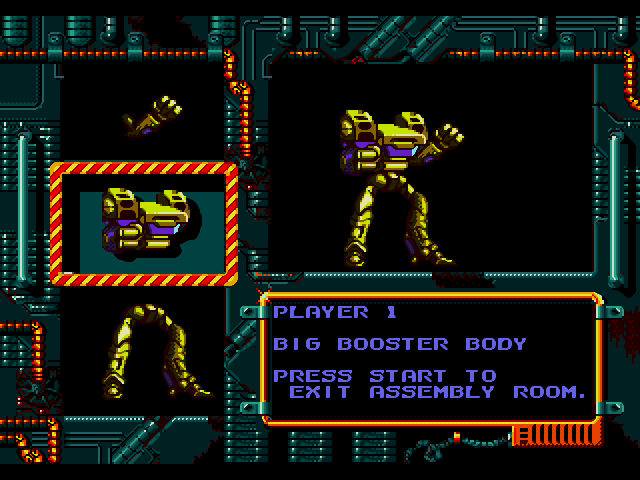
There are some unique features that make Cyborg Justice stand out. When you start a new game, you will be asked to build your cyborg from a number of parts. Most of these, at least the legs and arms, will function as weapons or will have useful applications that will help you make your way past foes. There are numerous hand weapons such as saws, flame throwers and even a slow but powerful laser arm. Some of them will let you cut off body parts of opponents. Unfortunately most of these are too weak and easily avoided to make them useful, which is a pity, as they look dangerous and are fun to use. You can stun an opponent in order to use these weapons more effectively, but most of the time you won't really feel like you need to.


The legs, however, are much more important. You can get pneumatic legs if you struggle with double jumps and want an easy escape from enemies, and tank legs that take you across the screen, charging at your opponents and knocking them off balance. By far the most useful though, are the giant legs, which slow you down but make you tougher and negate the effects of traps that are occasionally scattered around. Torso parts are purely an aesthetic choice and add little to the gameplay at all. There are some creative ideas for the part selection screen like the hand that you can launch across the screen (although you'll then have to pick it back up again), although the game simply lacks the balance required to make most of these choices worthwhile. Chances are that you will simply come to rely on one part you've chosen in particular..

This balance issue is mirrored by the vast array of moves you can use. Again, Cyborg Justice shows its' potential by providing a large amount of choice before promptly making that element of choice worthless. You can do shoulder charges, backflips, leech energy from opponents, uppercuts, dropkicks - yet a handful of these are so overpowered you'll come to rely on them. The jumping dropkick in particular is devastatingly powerful, and there is one move that you can use to steal an opponents hand weapon (not that you would ever need it). You can then add insult to injury by throwing it at them, which will usually take off most of their health. You can even score an easy kill by using the same move for a second time, which will allow you to pull apart their torso for an instant kill. That's not all - the game then allows you to use the torso of the hapless foe to restore a very large chunk of health. Regardless of how much health your opponent had when you severed their torso, it will still restore the same amount every time.

If that sounds very fun, it is, and you get rewarded for "brutality" by gaining a score at the end of the level. But it also makes the game far too easy. It appears the intention of Cyborg Justice was to combine the moveset of a tournament fighter with the swarming chaos of a sidescroller. Unfortunately, there are never more than two enemies at once, completely negating the effect. Not being able to fight more than two cyborgs at once doesn't really help mitigate the lack of challenge provided by the default difficulty setting either.

To demonstrate the level of depth the gameplay of Cyborg Justice strived for but never achieved, you can put opponents back together or pick up body parts that are left over. This will also add extra to your score at the end of each stage, as pointless as that was by 1993. What makes this difficult to pull off is that after defeating an opponent, their body will explode within a few seconds, so you have to be quick if you want to use their remains. But this is no easy task, because the controls for picking up body parts can be very stubborn and finicky. Often you will do a crouching shoulder charge instead, and the game demands laser like precision when picking things up. Overall it's just not worth the bother. One of the most frustrating elements is that between opponents there will be rockets flying at you. No explanation is given for this besides spurring you on and it just feels like an annoyance rather than adding anything useful to the game. Additionally, lock-on seems almost random, and dealing with enemies behind you is needlessly difficult. It speaks volumes when the only difficulty a game presents is unintentional or due to awkward controls and weird, out of context missiles flying at you.

As if a low difficulty weren't enough, Cyborg Justice is fairly short too, and will take you probably around 4 hours to finish, at the most. There is also a co-op mode. This is the only part of the gameplay that doesn't suffer from being too easy, as you can both damage one another. It's hard not to recommend co-op in most games, especially a Beat em' up. Multiplayer also features a one on one, but it doesn't amount to much and is over all too quickly, and thus adds little replay value.

The gameplay may not achieve what it sets out to accomplish, but at least the boss fights add an extra flavour. At the end of the three stages on every level, you come up repeatedly against the same decidedly ordinary looking robot, besides being purple in colour. However, it makes quite an entrance. It shoots orange crescent shaped beams from somewhere off screen, before making an appearance. It's the only enemy that uses the laser weapon effectively, and won't hesitate to use it to kill you in two hits or less, or by pulling off your torso. This, at least, will jolt you from your own complacency and serve as a lesson in ironic punishment for the trail of enemy torsos you've left behind in your wake.

Cyborg Justice looks reasonably good, the character design is interesting if a bit repetitive. All enemies are made up of the same parts you can choose at the beginning, apart from the 'default' torso. It certainly won't amaze you with visual effects or anything like that. The level design is functional, at best, and given that each stage within a level is identical with a different colour palette, you'll soon get bored of the scenery. Chances are you'll be too focused on watching all the crazy backflips and somersaults that make levels look like a circus show with robots to even notice the scenery anyway. There are shadow effects, but these just consist of a black circle underneath each cyborg. Cyborgs are well animated and when you walk backwards, it almost makes them look like they are moonwalking along to the game's funky soundtrack.


Speaking of which, the music and sound effects are probably the highlight of the game. The boss music is particularly good, making use of the Mega Drive's punchy bass for an atmospheric track. Sound effects have a nice metallic echo as you would expect from a game featuring cyborgs, but the impact of the moves result in a lot of impressive clanks and thwomps.

Cyborg Justice looks like a shameless clone from a distance, but has enough unique elements to set it apart. It has an excellent, rhythmic soundtrack, customisation options and a vast array of moves for you to use. The front cover makes the game look like quite a brutal affair, and in fact it very well could have been. But despite having all the ingredients in place for being a serious challenger, Cyborg Justice disappoints by failing to fulfil that potential. If it had not been so easy and wildly unbalanced in its combat mechanics, it could have been a game that rivalled Streets of Rage or Final Fight.


Summary
+ Excellent soundtrack
+ Realistic sound effects
+ Plenty of fun moves to play with
+ Customisable main character

- Combat system is very unbalanced
- Short and fairly easy
- Backgrounds are bland and frequently re-used
- Controls are occasionally awkward
- Mostly predictable and repetitive A.I

Overall Score
5/10

.

Tuesday, 6 November 2012

XCOM: Enemy Unknown


System(s): PC, Xbox 360, PS3

Genre: Strategy RPG

Developer: Firaxis Games
Publisher:  2K Games

Release Date: October 2012


Note: This is for the Xbox 360 version only

XCOM: Enemy Unknown is a remake of  XCOM: UFO Defense, also known as UFO: Enemy Unknown in PAL territories. For those who, like me, have had no previous experience of the XCOM series, the original was dreamt up by Julian Gollop of the now defunct British studio Mythos Games and published by MicroProse in 1994, who were also known for publishing the earliest of Sid Meier's Civilization titles. So it is fitting, then, that Sid Meier's studio Firaxis should be the one to replace Mythos as the developers of this re-boot.

XCOM is a Strategy RPG which takes place against a backdrop of alien invasion. These aliens are not like the "skinny aliens from the James Cameron movies" to quote Roger from American Dad!, but are in fact a mixture of diverse, yet terrifying forces, some borrowed from popular culture. In order to defend Earth from the invasion, but also to try and turn the tides of war in their favour, several countries have banded together and contributed funding and troops for an organisation called XCOM. You are put in control of the organisation and are responsible for controlling troops and managing resources. This gives you two major aspects of gameplay to focus on, and makes for a very addictive game.

You can choose to play a tutorial mission to get you started, although it's the default option so if it's your first game then you can jump straight in. The tutorial is as good as can be expected from a re-imagining of a series known for it's punishing difficulty. There is the usual easy, normal and hard modes (called "classic", a hint to series veterans they may want to start off there), and an impossible mode that gives me nightmares just thinking about. It goes without saying that, like many games released nowadays, this XCOM is nowhere near the challenge of the wildly unbalanced original games, which were unmerciful at best.

When you start a mission, you direct your troops like you would in a real time strategy game, except you can move only a certain distance, since it's turn based. This gives the illusion of freedom of movement given it it isn't strictly grid based. At the end of your move you can either overwatch, which allows a free shot against moving enemies, or shoot straight away if an enemy is in sight. If you want, you can move your unit even further by "dashing", at the cost of preventing you from carrying out another action. Shot accuracy is displayed as a percentage, created by a random number generator. It calculates the accuracy based primarily on distance and weapon type, although you can flank enemies to increase it.

Learning to find cover and using it effectively is essential to surviving in this game, which is at denoted by blue shields. Cover can either be full or half, which signals how likely you are to dodge. A red shield means you will be under no cover or flanked in that position. If you or an enemy miss, you can destroy cover, as well as ignite cars and other objects on fire, rigging them to blow next turn. However, sometimes the game doesn't entirely make clear whether cover is good or not, since it can extend in four directions. You need to be especially aware of where your enemy is, or even might be emerging from when deciding to send you squad into new cover positions.

There are mission varieties, such as bomb disposal, escorting key officials and UFO crashes or landings. Admittedly though, most boil down to killing everything you see. The toughest of these missions are terror missions, in which you have to guide your troops to civilians to save them before they are killed by the enemies roaming the level. A unique enemy appears only on this stage that can dead soldiers or civilians into zombies, which provides a special and memorable challenge. What makes this mission type and the bomb disposals particularly cruel is the way it takes everything you have learned about how to play XCOM (patience and forward thinking) and turns it on it's head. It's very difficult to avoid the temptation to rush ahead, and the game does a good job of conditioning you to think carefully before taking a turn. XCOM also gives the enemy a free move as soon as they come within your sight range. This may seem unfair, but is meant to enhance the overall feeling that you are fighting against a more organised and technologically superior force.

XCOM has a variety of interesting mechanics integrated with its' strategy gameplay that make the combat much more compelling and the controller very hard to put down. The most striking of these is that it gives your soldiers a nationality (there are 29 in total) and a corresponding name. This accomplishes two things. First, it makes you care if your soldiers die. Which they will. A lot. Much like Fire Emblem and Cannon Fodder, characters will die and never come back, which encourages you to replay levels or change your strategy. Soldiers also level up and gain new ranks and unlock new abilities, which adds to the distress of losing your highest ranked soldiers. Granted, soldiers don't get back stories. But they earn nicknames based on class as they reach a certain rank, which is another way the game builds emotional connections, albeit rudimentary ones. You can also customise their appearance and names. This can enhance the sense of disappointment should they die, if you are the type who names characters after relatives or friends.

Secondly, having a diversity of nationalities adds substance to the plot. If the military of XCOM were entirely made up of buff, cigar smoking American marines, it would be very difficult to relate to. But the game attempts to make you feel a bit like you are re-creating the scene from Independence Day when the Iranians are cheering at the news the Americans have shot down an alien craft. The difference being that, unlike Hollywood, it feels like it's more than just the U.S saving the day while everyone else watches or does their part off-screen. As an example, you can have sworn enemies like Israelis and Egyptians fighting side by side. The sense of humanity banding together  and putting differences aside to save their species amid desperate times would probably be driven home a bit better if all the character voices weren't American though. Another oddity is that there are separate British and Scottish soldiers. Far be it from me to complain about that, but it does take some of the realism away. But overall, these complaints are fairly minor and, while they remove some polish from the game, it's not as though they can make the game less addictive.

The four classes in XCOM all have their uses. Initially you start out with rookies, which are generic, blank slates armed with assault rifles and grenades. When they promote into squaddies, they are categorised into one of four classes: assault, sniper, heavy and support. The game does a good job of balancing all four classes to make them useful, although in certain missions you might feel compelled to take more of a single class. When your rookies level up, they will randomly be assigned a class, although it is weighted slightly in favour of whichever class you need most. This is by no means perfect, and on occasion when playing the game, I seemed to be short of the support class more than most, even throughout five different save files.

Eventually, you will unlock other abilities that can be used rather than shooting normally, many of which are class specific, such as firing rockets for heavies or taking headshots for snipers. The skill tree is very basic, there is mostly just a choice between two abilities. Some of these choices don't feel difficult to make, but largely the system gives you plenty of food for thought. Do you want a support unit that can carry extra medkits and sprint further, or one that carries extra smoke grenades which also provide a boost to the stats of any soldiers concealed within the smoke cloud? You can initially take only four soldiers, so taking one of each seems a no-brainer, but when you unlock up to six, the real tough decisions on squad management begin. It's tempting to be overcautious and bring extra medics
 at the expense of firepower, but doing so can be costly in some missions.

At the end of your first mission, you will choose which of the five continents your base should be built in (Australasia is consolidated into Asia). Depending on which continent it is built it will give you a bonus, which can be helpful or useless, whatever suits your play style. You view your underground base in between missions in a cross section view, which resembles an ant farm. There are various screens, which are handled seamlessly through sub menus. Your research lab allows you to assign projects to develop counter-threats. Engineers build your base as directed to manage resources and create useful items and your hangar and barracks let you build up, customise, upgrade and outfit your ground and air forces. Scanning the globe in the mission control menu advances time and brings up abduction or UFO warnings.

Managing your cash and using it in each of these key areas is the core of the resource management. Failure to build satellites can leave you with high panic levels, for instance, while poorly directed research can leave you struggling to kill mutons with assault rifles when you wish you had laser or plasma weapons. This also gives the game replay value, as you might try and challenge yourself to complete the game differently or start your base elsewhere next time for one of the other bonuses to see how it would affect your game. The game also has one-on-one multiplayer where you can mix and match alien and human squads against another player. As if you needed another excuse to keep playing......

The situation room is where you will observe the panic levels of the council countries which make up XCOM, which will rise if you fail to protect them and complete missions. Managing these panic levels is key to the base building. Every so often, for example, an alien abduction mission will show up and you will have a choice of which country to assist. The countries who were not picked will see a rise in panic levels, along with other countries on that continent. If unchecked for too long, panic can cause a country to exit the council and withdraw support and funding, making the game even harder.

Launching satellites and completing missions will reduce panic, as well as bringing you rewards like a new advanced soldier or cash. And that's not all - sending satellites to monitor all countries on a single continent will grant you one of the aforementioned base bonuses. Each country provides money at the council report each month based on your performance, as well as scientists and engineers. If you are low on cash and weeks away from a council report, which is a lingering danger in XCOM, there is a market where you can sell items you have picked up from defeating enemies, although selling too much can be risky, since much of what you recover can be used in research and engineering. This carrot and sharpened stick approach of offering rewards combined with risk is part of what makes the game so compelling, as well as the feeling that your decisions carry such incredible significance and can come back to bite you later on.

XCOM may be a difficult game at times, but it is always fair, and it does a great job of introducing you to gameplay elements without completely overwhelming you. To illustrate this, enemies come in many flavours, and gradually you will encounter tougher enemies. Some of these, like floaters or thin men, are just a nuisance, but cyberdisks and zombie-spawning chryssalids can eventually trouble you in a massive way. But although you will need new strategies to beat these threats, you will in theory by that point have acquired a highly trained squad and high tech weapons. All in all, RPG elements bring a lot to the XCOM table, but that's just the icing on the cake. The gameplay and, in a sense, the difficulty and pacing is deeply affected by how you handle the base building.

Graphically, XCOM looks great by turn based strategy standards, although some environments are re-used frequently. There are only so many times you can assault a grounded enemy UFO in the same half destroyed forest. Saying that, usually you will be so caught up in the gameplay you don't really notice. Sounds and music are suitably eerie too. It uses the Unreal 3 Engine, although it's not without the odd bug or glitch. It defeats the purpose having slick, slow-motion action sequences when these are frequently where much of the bugs in the game can be found. I have had the game freeze on me and give me random disc read errors for no reason, as well as delaying quite a bit when enemies take their turn.

Other frequent issues include shooting through walls, soldiers facing the wrong way when shooting, some texture pop-in and clipping problems. I have also had issues with the DLC Elite Soldier pack, which allows you to further customise soldiers. In theory anyway: in my copy it just crashes the game and sends me back to the Xbox dashboard. I haven't played the PC or PS3 versions, but I have been made aware of similar problems on those platforms, except for the DLC content, which seemed to exclusively affect my version. On the subject of platform, strategy games may have their issues with controllers, but XCOM handles this very well. Although faster load times and a mouse would have been convenient, at no point did I feel the game suffered without a keyboard and mouse. Given the way the cursor handles free movement, the analogue controls are probably the best you are going to get for a strategy game on a console.

While you might experience the odd bug along the way, you will still be unable to put XCOM down. It surely won't be the sequel hardcore fans of the series were hoping for but it holds it's own brilliantly enough to capture a new generation of fans. For all the minor flaws XCOM has it will still suck you into it's game world with it's enjoyable setting, excellent pacing and strong level of challenge. The base building, RPG elements and permanent deaths will give you a chill down your spine as you lament the death of your fallen comrades at the hands of a muton berserker or deadly cyberdisk - knowing full well that you share full responsibility for sending a highly trained team out to die and leaving a country in ruins. For in XCOM, every decision can lead you staring down into the empty abyss of total annihilation unless you have patience and cunning. And even if it does come to that point of humanity falling into a yawning, darkness-filled chasm, it will still leave you wanting more.

Summary
+ Challenging yet well-paced
+ Enjoyable combat and cover system
+ Great replay value
+ Addictive RPG levelling and micro-management are seamlessly integrated
+ Great use of setting to draw the player in

- Occasional frustrating technical issues and bugs
- Frequently reused environments

Overall Score
9/10


Wednesday, 17 October 2012

Baten Kaitos: Eternal Wings and the Lost Ocean


System(s): Gamecube

Genre: Turn-Based RPG

Developer: tri-Crescendo/Monolith Soft
Publisher: Namco

Release Dates:
Japan - December 2003
North America - November 2004
Europe - April 2005
Australia - May 2005


Baten Kaitos was a title released in 2004, published by Namco and co-developed by Monolith Soft, the company behind the critically acclaimed Xenosaga, Xenogears and Chrono Cross series of JRPG’s; and tri-Crescendo, the company that developed the visually stunning Eternal Sonata. As one of the few RPG’s (and one of the last) on the Gamecube, it was met with much anticipation by fans.

For a long time, story has been the benchmark for which all great JRPG’s are measured. Well, on the story front, Baten Kaitos: Eternal Wings and the Lost Ocean is merely adequate. Evil emperor with a superior military force wants to revive a dark God to satiate his increasing megalomanial lust for power and conquest, blah blah blah. It’s pretty standard stuff and it’s been seen many times before. There is a shocking plot twist involving the main character, but that’s to be expected, as that too has become a staple of the JRPG genre. Having said that, the plot twist is quite a significant one, which changes entirely how you view the earliest parts of the game and gives you food for thought. The game is a good 45 hours long, not counting side quests. This means that, although there isn’t much replay value, it will take you a while to finish it the first time and give you plenty of entertainment.

As far as the characters go, besides the vengeful protagonist Kalas, mercilessly teased from childhood because he has only one wing, most appear very one dimensional at the beginning. It takes them some time to really grow, although they largely fit standard JRPG archetypes i.e. rebellious villager, mercenary with a dark past, unwilling soldier and hot-headed young guy. The one character that truly stands out is the enigmatic Mizuti, a diminutive wizard who wears something resembling an Aztec mask and refers to herself in third person (as the “Great” Mizuti much to the bemusement of the other characters, especially Kalas). Mizuti serves as the comic foil. This is in spite of her being a kind of Deus Ex Machina, saving the party and advancing the plot on many occasions. In addition, Mizuti’s dialogue is delivered excellently. The rest of the characters do grow and develop somewhat later into the game, so it is forgivable that they start off a bit flat and uninspiring.

Although the story doesn’t particularly stand out, and the characters are slow to develop, one thing does make Baten Kaitos stand out, and that is the setting. The legend goes that long ago, there was a war among gods that evaporated the oceans, leaving behind a toxic miasma on the earth. For some unspecified reason the game never explains, the land floated into the air, and the inhabitants evolved wings, called “Wings of the Heart.“ These are not strong enough for them to fly great distances, however, and characters rely on large creatures somewhat similar to whales for transport between islands.

To make things more complicated, you play the role of a “guardian spirit” that bonded to Kalas, and is thus always with him. This involves you more directly in the story but without breaking the fourth wall, as characters will not only directly address you by name, but occasionally ask you for a response. Sometimes this works, and other times it feels a bit jarring. The setting of floating islands paves the way for some great design by the developers and some interesting locations. An entire land made from islands floating among the clouds with winged inhabitants sounds pretty intriguing in itself but that’s nothing compared to a fairytale inspired village made of confectionary. There is even a dungeon that serves as an homage to classic pixelated masterpieces such as Namco’s own Pacman. There were obviously some very creative minds at work on this game and it shows.

Or perhaps eccentric is the word. The game introduces a few radical ideas, some of which work, some of which don’t. The ideas that occupy the middle ground here include interesting side quests and a card based battle system (before you hardened JRPG veterans recoil in horror, it works surprisingly well). The side quests are interesting, although they are few and far between. Some of those you receive last the duration of the game. Highlights include collecting star constellations for display on a church roof and gathering a dying man’s extremely large extended family. As for the card battles, card games themselves are not overly popular except with a specific demographic, which lessens the game’s appeal to a broad audience; simply put, many people won‘t appreciate using cards to fight, although there’s not much to separate it from many Final Fantasy games in how much control you ultimately have over your character. This shouldn’t take anything away from the game, as Baten Kaitos combat is mostly simple and quite engaging.

Since card games are based on a great deal of luck however, the lack of control over your allies during battles can be made more frustrating, particularly during some very tense boss fights. Paying attention to the cards you have been dealt at least mitigates the time you spend watching long, drawn-out cut scenes during battle, as your character moves to attack while you are still selecting more cards to use. This means battles are not quite the slow, grinding chore they can be in other turn-based games. You also need to think quickly, as you have limited time to pick cards before your enemies physically attack you. However, you can customise your deck in the inventory screens like you would equipment in any other turn-based JRPG, so as long as you are well prepared, most enemies other than bosses shouldn’t pose a huge problem.

There is elemental damage infused in certain offensive cards, as well as special attacks. Oddly, unlike traditional water-beats-fire elemental systems in JRPG’s, elements beat those that are directly opposite to them i.e. light beats dark but dark, in turn, also beats light. This increases the strategic element and makes it all the more satisfying when you land a good combo of elemental hits on a foe weak to that type and finish with a special move. There is one strategic idea linked to the use of cards that is quite confusing though, and the game never really adequately explains it. Each card has a number in the corner, and stringing together combinations of numbers nets you bonus damage. That part is easy enough. Where is gets confusing is there are over a hundred unique combos to discover by using certain items in battle along with weapons and armour in a particular order. The game never tells you what these items are or what order they should be used in and, in theory, you could have fun discovering this, but the combination of items appear random and the game never really encourages you to find out. Sometimes you’ll do it by accident, which just increases the sense of frustration.

On the plus side, the special attacks are fun to watch and the dark elemental specials look particularly stunning when unleashed. Cards do play a reasonably important part in the plot (which the game refers to as ‘Magnus’). Five special cards called “End Magnus” when brought together, are what releases the dark god that forms the main antagonist later in the game. But even more importantly, what is truly innovative about cards is that they are used in-game to store items.

Not only are all healing items and equipment stored on Magnus, but special quest items. You can store up to five items at a time, and these, as well as regular cards, can change depending on the circumstances. This means that your fruit can rot, water become stagnant etc. and quite literally this brings an extra dimension to the gameplay. This change also affects their use in battle. What used to be a healing item such as an apple, becomes a good means of poisoning your enemy once it has rotted, although quite how hurling raw pork ribs or blackened bananas at your enemy causes them decent damage is a mystery. There are no monetary rewards for finishing battles in Baten Kaitos, which is instead earned by placing a camera in your deck and taking photos of monsters. This can sometimes up the ante in boss fights, as you will want a photo of the boss to sell for a significantly high price, but will need to spend a character’s turn doing so. One of the more frustrating decisions made by the developer was to only allow levelling up from churches. These are located in towns far from dungeons, so if you aren’t careful, you can end up going into dungeons weaker than you intended.

The sound is perhaps the weakest component of Baten Kaitos. All main characters relevant to the story are fully voiced, as well as numerous minor characters. In short, if they are given a name by the developers, they speak, which is fairly impressive considering the number of characters. It’s worth noting that the voice acting was purposely made to sound slightly distant because of the player‘s role as an incorporeal being, which many reviewers and players alike failed to pick up on at the time of release. However, the game does not explain this, but rather leaves the player to figure this out themselves, so the negative press given to the sound is not surprising. It was an interesting idea but perhaps a bit too clever, and affects the voice acting in a way that is difficult to ignore. Not to say the voice acting is terrific, but for a game originally released in 2004, it isn’t as painful as it could have been, so long as you can handle the aforementioned surrealism of hearing all the characters sound like they have a bucket on their heads.

The dialogue is excellently written, but the quality of the voiceovers can vary. If it starts to grate, though, there is always the option to turn it off. By contrast, the rest of the sound is excellent. JRPG’s frequently sell soundtrack CD’s, and it’s not hard to see why, as the music is beautifully composed by Motoi Sakuraba and lives up to great JRPG standards. Again, the land of Mira is a particular highlight. The cleft between dimensions, where the characters get somewhat lost, is musically scored so as to invoke a sense of wonder and eeriness.

Presentation wise, there are some great C.G.I cut scenes in the game at key moments, and the character status screen has some nicely drawn character art. Aside from that, presentation is largely standard for a JRPG. What makes Baten Kaitos impressive, graphically speaking, is the beautiful pre-rendered backgrounds. This game looks gorgeous, and really shows off what the Gamecube is capable of. This skilful use of pre-rendering is similar to what Capcom accomplished with their remake of Resident Evil, only with much more vibrant colour and detail (and less flesh eating zombies, obviously). It’s not so much the technical side of the graphics that really stand out but the art style. The setting really comes to life thanks to the gorgeous artwork. This game is like a fairytale picture book come to life, despite being a little rough around the edges. Character models are well drawn, and having character art pop up on screen in dialogue boxes to accompany the spoken dialogue is a nice touch, particularly as each piece of artwork changes based on the emotions of the character. The character animations when running are pretty comical and exaggerated, almost cartoon-like, but you can forgive this because most players will be too busy picking their jaw up from the floor after viewing the stunning scenery.

Overall, Baten Kaitos: Eternal Wings and the Lost Ocean is a fairly lengthy JRPG that tries to do something radical in certain areas. Due to this, the voice acting sounds off and some characters are wooden or unlikeable to begin with, but they don’t ultimately detract from what is a great 45 hour experience. Assuming you are undeterred by the thought of card-based combat mechanics, I would highly recommend giving the game a look if you like JRPG’s. When so many games in the genre struggle to set themselves apart from Final Fantasy, it is refreshing to see one so boldly set out to do things differently. Despite the fact that the gamble the developers made with the game’s design doesn’t always pay off, the unique setting, colourful scenery, graphical presentation and solid, if somewhat quirky gameplay make this arguably the best JRPG's on the Gamecube, and one of the best of it's console generation.


Summary
+ Beautiful graphics, especially the pre-rendered backgrounds
+ Unique card battle system brings plenty of strategic thought
+ Radically new gameplay ideas that implement a fresh, strategic element
+ Great soundtrack
+ Creative & unique level design

- Apart from the odd plot twist, story is pretty standard fare and characters are slow to develop
- Voice acting sounds odd
- Boss fights can be frustratingly difficult

Overall Score
8/10